Visual Astronomy & Deep-Sky Hunting
Seeking out visual targets that I have never seen before requires far more than just pointing a telescope at familiar objects; it demands systematic target selection, precise charting, and careful logging. I use SkyTools 4 to track my visual logs, keeping extensive lists of unobserved targets ranging from faint planetary nebulae to extragalactic globular clusters and distant quasars. You cannot see something new if you do not know what you have already seen, making detailed logging the essential first step for any deep-sky observer.
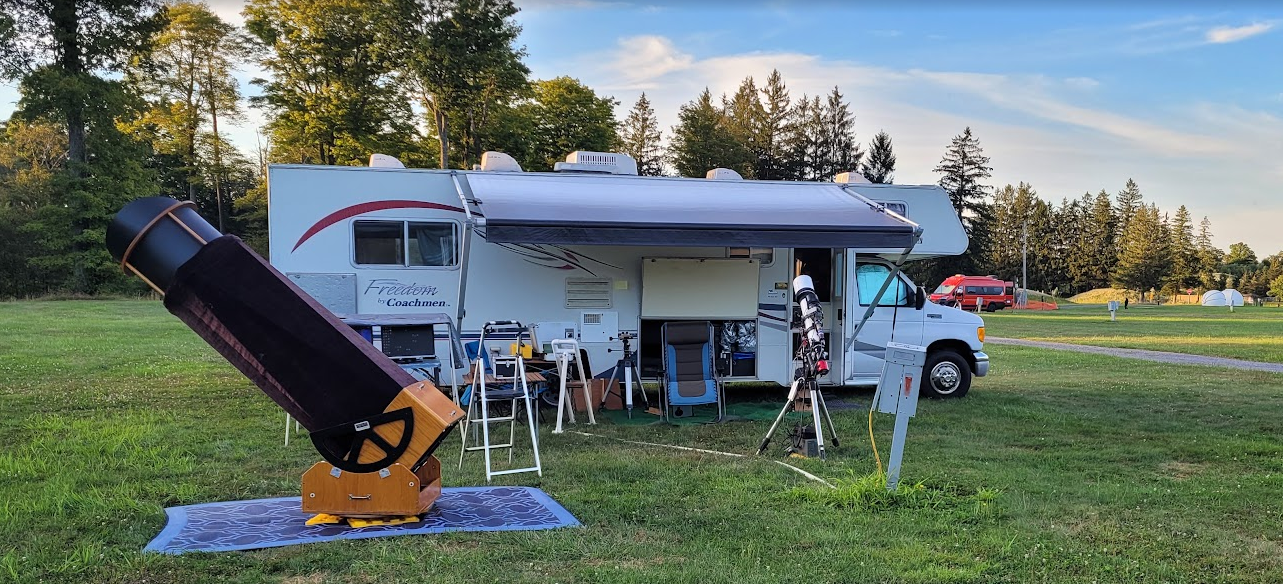 My 20-inch StarMaster Dobsonian setup under dark skies.
The Primary Visual Rig: 20-Inch StarMaster Dobsonian
My primary visual instrument for deep-sky hunting is a 20-inch StarMaster Dobsonian (f/4.5). It is fully motorized and equipped with a custom ASCOM driver linked via a serial-to-Bluetooth adapter, allowing complete wireless control from a tablet or field laptop.
While the StarMaster is a masterpiece of craftsmanship, large truss Dobs inevitably experience minor mechanical flexure, ground shifting, and slight balance shifts as heavy eyepieces are swapped. When hunting targets near the limit of human vision, finding the exact field of stars is ninety percent of the battle. Spending valuable observing time climbing up and down a ladder to re-verify star patterns against paper charts quickly became a major physical bottleneck.
The PiFinder Revolution
Integrating a PiFinder plate-solving device onto the 20-inch Dob transformed my visual workflow completely:
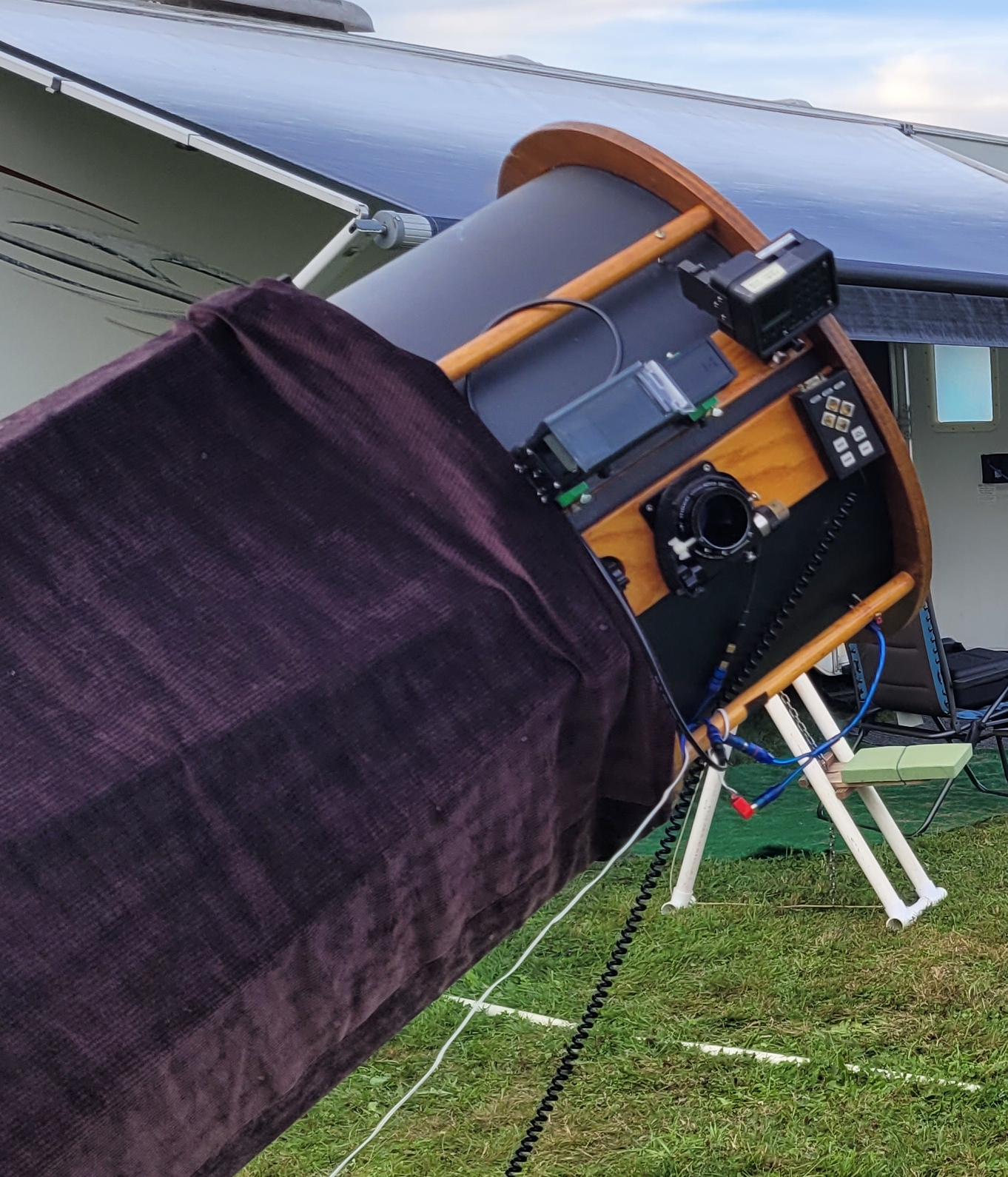
- Eliminating Ladder Fatigue: The onboard camera identifies the exact pointing position of the telescope instantly, saving dozens of physical trips up and down the ladder during an observing session.
- Focusing on Tracking, Not GoTo Drift: I no longer worry if motorized GoTo alignment shifts slightly over the course of a long night. As long as the mount tracks steadily, the PiFinder delivers exact, real-time positional coordinates.
- Extragalactic Target Hunting: Getting onto the precise star field makes hunting extremely faint targets, such as quasars billions of light-years away or extragalactic globular clusters in the Andromeda Galaxy, both practical and immensely rewarding.
The PiFinder plate-solver mounted on the optical tube.
Milestones at the Eyepiece: Pluto, 3C 273, and Q1626+6433
My passion for visual observing has always been driven by pushing optics to their extreme boundaries.
Star-Hopping to Pluto
Early in my observing journey, I set out to spot Pluto when it was still classified as a planet. Commanding a GoTo telescope gets you close, but in a crowded field of fifty identical-looking faint stars, finding the right point of light demands painstaking chart matching. Spending over thirty minutes alternating between the eyepiece and software star maps until the pattern clicked remains a core memory of star-hopping discipline.
The First Quasar: 3C 273
My search for extreme distance led me to 3C 273, the brightest active quasar in the Virgo constellation. Located roughly 2.4 billion light-years away, the light reaching my eye left its source when cyanobacteria were first inventing photosynthesis on Earth. Seeing that dim point of light sparked a lifelong fascination with active galactic nuclei.
The 11-Billion Light-Year Horizon: HS 1626+6433
That fascination culminated at a regional star party when I set my sights on HS 1626+6433 (Q1626+6433) at magnitude 16.1. With a lookback time of approximately 11 billion light-years, it required extreme concentration and averted vision, with the faint signal popping into view only occasionally across moments of steady seeing. Sharing that view with fellow observers and reflecting on photons that traveled across most of the age of the universe to hit our retinas is the absolute pinnacle of visual astronomy.
Optics and Eyepiece Selection
A fast f/4.5 focal ratio leaves no room for optical compromise, as fast primary mirrors reveal optical aberrations instantly in sub-par glass. Over time, I refined my eyepiece collection down to a handful of exceptional, high-contrast optics, supplemented by a Siebert 1.5x Barlow to bridge magnification gaps without adding unnecessary glass surfaces:
- Tele Vue Nagler 31mm Type 5: Wide-field finder and low-power scanning eyepiece.
- Tele Vue Ethos 13mm: High-contrast, wide-field workhorse for deep-sky target detail.
- Tele Vue Nagler 9mm Type 6: Mid-to-high magnification for compact planetary nebulae and cluster resolution.
- Tele Vue Nagler 5mm Type 6: High-magnification planetary and small deep-sky target eyepiece.
- 12mm Illuminated Reticle Eyepiece: Dedicated alignment and centering aid.
The Origins: Binoculars, The 8-Inch Dob, and DIY Innovation
My return to astronomy as an adult began about a year after moving to a new home. Looking up from my back deck on a clear, moonless night, I caught a crisp glimpse of the Milky Way across the sky for the first time in years. That single moment re-ignited my childhood curiosity, sending me on a journey to explore what else was hiding in plain sight.
Remembering the frustration of my childhood department-store refractor, I resolved to research carefully before buying gear. I started with a good pair of binoculars, making my first intentional find: the Andromeda Galaxy on a freezing December evening. I joined my local astronomy club, the Greater Hazleton Area Astronomical Society, where members confirmed my choice for a first scope: an 8-inch Discovery Dobsonian.
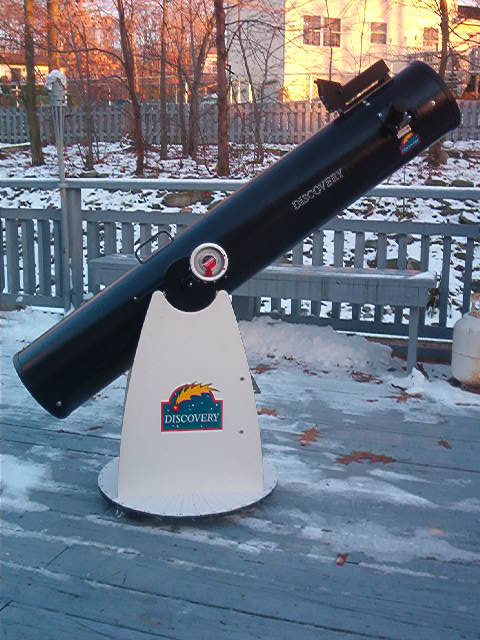
My original 8-inch Discovery Dobsonian set up on the back deck, featuring the red carpenter's float level mounted at the altitude pivot and the Telrad finder up top.
Manual Setting Circles and the Birth of AstroHelper
While the 8-inch mirror delivered wonderful views of bright targets, finding faint objects that were invisible to the naked eye remained a real challenge. Being a software developer by trade, I wrote my own program to calculate an object's precise Altitude and Azimuth every minute to track the Earth's rotation.
To translate those calculated numbers directly onto the telescope without commercial digital encoders, I built a custom hardware setup:
- Measuring Altitude: Before digital levels were common, I mounted a classic red carpenter's float compass directly to the optical tube at the altitude pivot to read exact elevation angles above the horizon.
- Measuring Azimuth: I printed out a 360-degree circle spread across multiple sheets of paper, carefully cut and reassembled the ring around the edge of the stationary Dobsonian base board, and added a hand-crafted pointer.
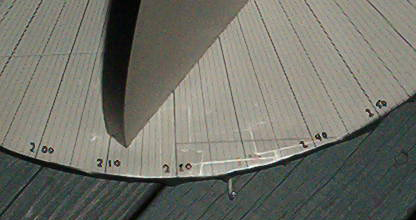
The pieced-together, hand-marked 360-degree azimuth setting circle and pointer on the base of the Discovery Dob.
That simple combination of trigonometry, printed paper, and carpenter tools unlocked hundreds of deep-sky objects and laid the mathematical foundation for what later became AstroHelper. Observing creation in this quiet, hands-on way became a genuine form of worship.
Public Outreach and Daytime Solar Observing
Sharing the night sky with others requires a very different strategy than personal deep-sky hunting. Large truss Dobs and tall ladders are not ideal for young children or crowded public events, so I rely on dedicated outreach setups designed for safety, comfort, and engagement.
Nighttime Outreach: The Schmidt-Cassegrain C11
For public stargazing, my slow and forgiving f/10 Celestron C11 is the perfect instrument. It instantly communicates serious observing to visitors, providing high magnification and light-gathering power that cuts through light-polluted park settings.
- Baader Hyperion Zoom Eyepiece: A versatile, high-quality zoom eyepiece reserved specifically for public sessions, allowing quick magnification adjustments without swapping glass in the dark.
Daytime Solar Outreach: Hydrogen-Alpha
My Coronado PST solar telescope mounted on an Atlas EQ-5 mount brings the dynamic sun directly to the public, showing solar prominences and flares in hydrogen-alpha wavelengths.
Safe Solar Projection: The DIY Eclipse Viewer
I also bring a home-built Safe Solar Viewer mounted on a small tracking EQ-2 mount. It projects a bright image of the sun and sunspots onto an internal screen, allowing families and groups to observe sunspot movement safely together.
Questions, Troubleshooting, or Getting Started?
If you are struggling with a telescope setup, curious about custom DIY modifications, or trying to figure out what gear makes sense for your local sky conditions, please feel free to reach out to me through my Contact Page. I am always happy to talk shop, troubleshoot an optical issue, or help a fellow observer get back on track.